Video surveillance in residential buildings: what you can film at home, in the entrance and in the yard
October 9, 2026
People put cameras in residential buildings for obvious reasons: parcels and bicycles go missing, someone damages the lift, strangers park in the yard. But in an apartment building a camera films more than just you — it films your neighbours, their guests and their children. That is why the Law of Georgia on Personal Data Protection treats residential buildings separately and distinguishes three situations: a private home, the door of your own apartment, and the building's common areas.
This is a practical overview, not legal advice. Article numbers refer to the official text of the law on matsne.gov.ge. The general rules for video monitoring are in the article on whether video surveillance is legal in Georgia.
In short: what you need, and where
Where the camera is | What you need | Basis |
|---|---|---|
Private house, your own yard and plot | nothing, if recording is only for personal use | Article 2 |
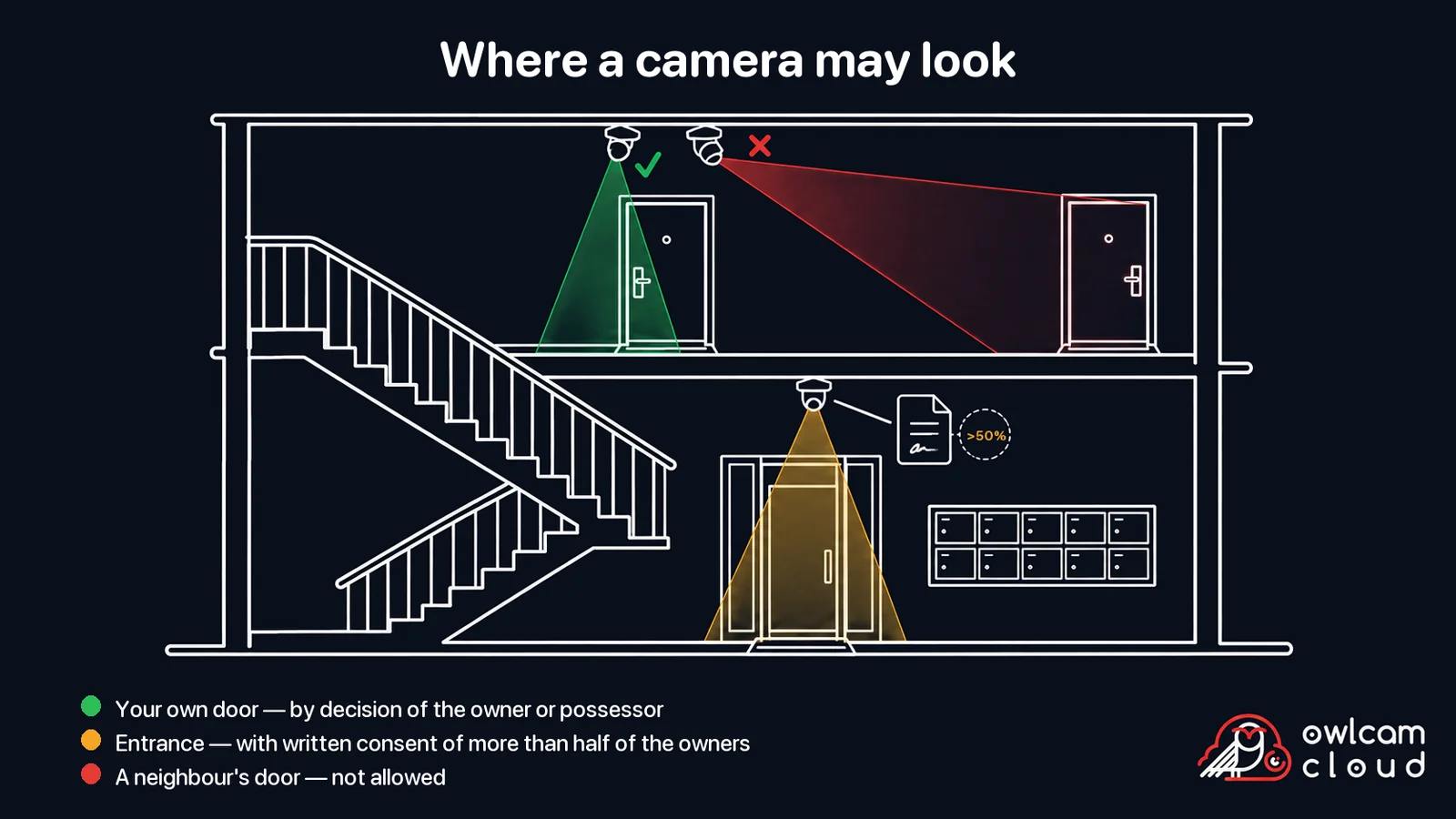
The door of your own apartment | a decision of the owner or lawful possessor; the camera must not harm your neighbours' interests | Article 10, paragraph 7 |
Entrance, stairs, lobby, shared yard | written consent of more than half of the owners | Article 10, paragraph 6 |
Changing rooms, toilets and similar places in common premises | not allowed, whatever the consent | Article 10, paragraph 4 |
A private house
The law does not apply when a person records purely for personal and household purposes, unconnected with business (Article 2). A camera covering your yard, your gate and the car on your plot is exactly that case: no signs, documents or consents are needed.
The line is crossed where the camera starts filming what is not yours: the street, a neighbour's yard, windows. The law has no express rule on this. But the more of someone else's territory is in the frame, the harder it is to call the recording "purely personal". The safe approach is simple: point the cameras at your own plot, and if part of the street inevitably gets into the frame, let it be the edge of the frame, not its centre.
A camera at the door of your apartment
A camera at the entrance to your own apartment may be installed by decision of the owner or the lawful possessor — a tenant, for example (Article 10, paragraph 7). Your neighbours' consent is not required.
There is one condition: the camera must not harm the legitimate interests of other people. In practice this means:
the camera looks at your door and the space directly in front of it;
the neighbouring apartment's door is not in the frame;
the camera does not film the whole flight of stairs — that is already a common area, and different rules apply to it.
Entrance, stairs and shared yard
Cameras in the common areas of an apartment building require the written consent of more than half of the owners (Article 10, paragraph 6). If an owner cannot be identified, consent can be given by the lawful possessor of the apartment.
There is one exception: consent is not needed if the monitoring is carried out by an organisation required to do so by law, and the monitored area includes the common entrance and common premises.
How to obtain consent
The law requires written form but does not prescribe a template. Usually it is done like this:
Agree on who is responsible for the cameras. This may be the homeowners' association or one of the residents entrusted with it. Their name and contact details will go on the sign.
Draw up a short document: where the cameras will be, what they film, how long recordings are kept and who may view them.
Collect the owners' signatures under this document. There must be signatures from more than half of the owners.
Keep the signed document — it confirms that the cameras were installed lawfully.
A sign is mandatory
Wherever the cameras are in the common areas, a sign must be placed in a visible spot (Article 10, paragraphs 8 and 9). It must show:
an inscription saying that video monitoring is in progress;
a clearly visible image of a camera;
the name and contact details of whoever is responsible for the cameras.
The last point matters: neighbours and guests must know whom to contact about a recording.
Where filming is not allowed
Cameras are prohibited where a person can reasonably expect privacy (Article 10, paragraph 4). In a residential building that means, for example, shared toilets or changing rooms at a gym or swimming pool. The owners' consent does not lift this ban.
The law has no separate rule on cameras pointed at other people's windows or doors. But such a camera almost certainly harms the neighbours' legitimate interests and is not proportionate to any security purpose. Do not point cameras at other people's windows, doors and balconies.
Who views the recordings
Recordings from the entrance are recordings of your neighbours, so it is worth restricting access to them in advance. Usually the person responsible for the cameras can view the recordings, and residents turn to them when something has happened.
Anyone caught on camera has the right to a free copy of the recording of themselves — the response is due within 10 working days (Article 14). A request to delete a recording is handled within the same 10 working days (Article 16).
The law does not set a retention period: recordings are kept as long as the purpose requires (Article 4). For an entrance, a week or two is usually enough — long enough to notice a missing parcel or a damaged lift and find the right moment.
Fines
For breaching the video monitoring rules, individuals, homeowners' associations and other non-profit organisations face a warning or a fine of 1 000 ₾. With aggravating circumstances, such as a repeat violation within a year, the fine is 2 000 ₾ (Article 69). For cameras in toilets and similar places — a warning or 3 000 ₾.
Why the cloud suits a building better
In an apartment building, a classic recorder has two problems. It has to be put somewhere — usually in the basement or an electrical room, from where it is easy to carry off along with the recordings. And it is hard to give several people access without handing everyone the same password.
Cloud recording solves both: recordings are not kept in the building, and they can be viewed from a phone with individual access. No public IP address is needed — cameras connect through the OwlBox device; more on this on the page about connecting without a static IP.
Checklist for an entrance
It has been decided who is responsible for the cameras.
There is a document: where the cameras are, what they film, the retention period, who views recordings.
It carries signatures from more than half of the owners.
A sign with a camera image and the responsible person's name and contacts hangs at the entrance.
Cameras are not pointed at apartment doors, windows or places where privacy is expected.
Only the responsible person has access to the recordings.
Want to install cameras in your entrance or yard? Contact us — we'll help you work out how many cameras you need and how to organise access to recordings.