Is video surveillance legal in Georgia? What the personal data law requires
October 9, 2026
The short answer: yes, video surveillance is legal in Georgia. But a camera processes personal data — faces in a recording are recognisable — so the Law of Georgia on Personal Data Protection applies. The new version of the law has been in force since 1 March 2024, and its requirements for video monitoring are more specific than before. Here is what you need to do for your cameras to follow the rules.
This article is a practical overview, not legal advice. Article numbers refer to the official text of the law on matsne.gov.ge, so you can check every statement.
When video monitoring is allowed
The law lists the purposes for which cameras may be installed (Article 10, paragraph 1):
preventing and detecting crime;
public safety;
protecting people and property;
protecting minors;
protecting secret information;
exams and testing;
other legitimate interests.
For a shop, office, warehouse or pickup point, "protecting people and property" usually fits. But a purpose is not enough: monitoring must be proportionate to it. A camera over the till or at the entrance is proportionate. A camera that watches one employee at a desk all day is a different question.
What a business has to do
There are four requirements, and all of them can be met in a day.
1. Put your decision on video monitoring in writing. The law requires you to set out in writing (Article 10, paragraph 2):
why monitoring is carried out and to what extent;
how long it is carried out;
how long recordings are kept;
who gets access to them and how, and how they are stored and deleted;
how the rights of people caught on camera are protected.
For a small business this is an internal document of a page or two. It does not need to be registered or approved by anyone in advance.
2. Put up a sign. A warning sign must be placed in a visible spot (paragraph 8). It must show (paragraph 9):
an inscription saying that video monitoring is in progress;
a clearly visible image of a camera;
the name and contact details of whoever runs the monitoring.
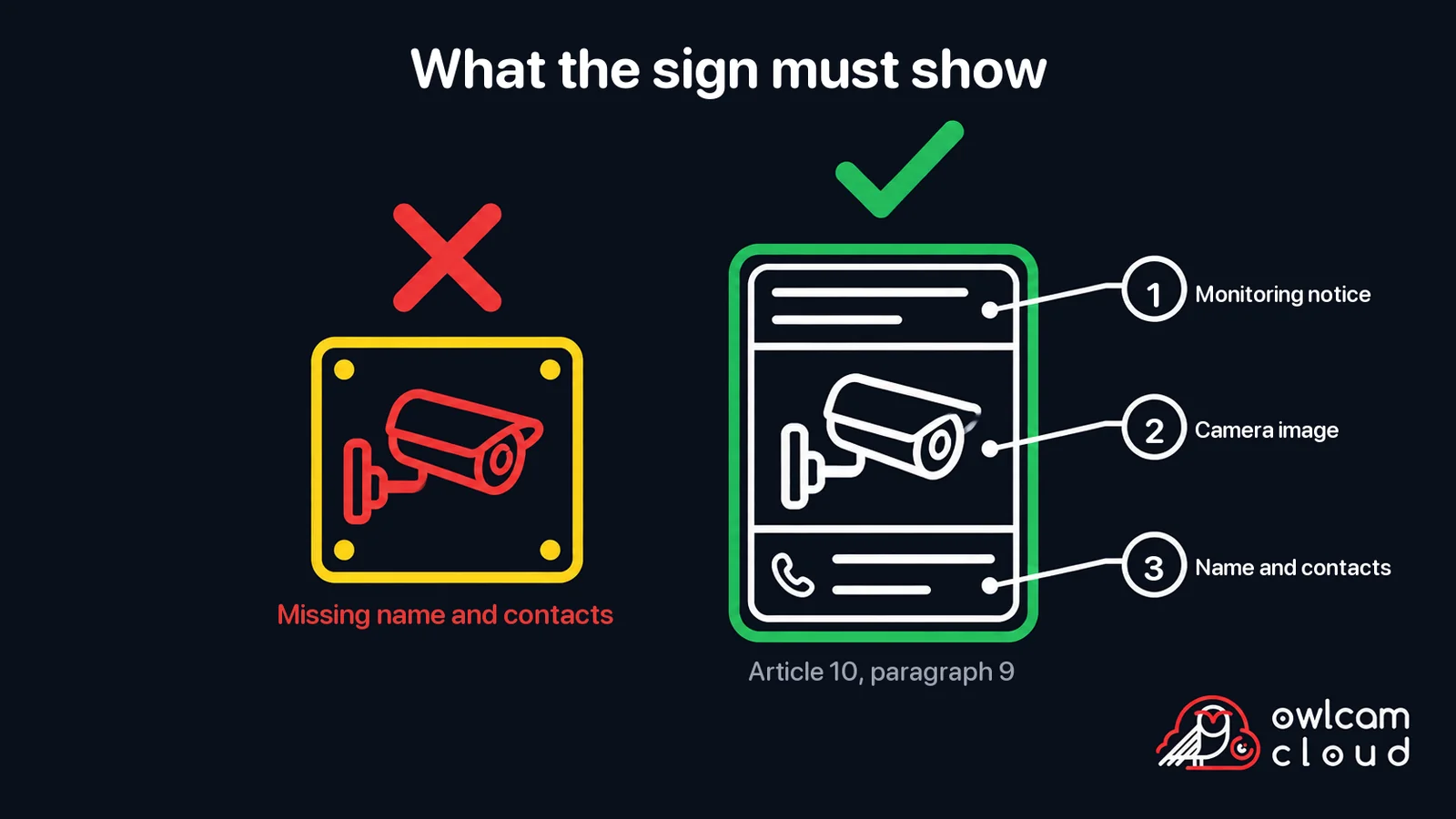
The last item is the one most often forgotten: a plain "CCTV in operation" sticker does not meet the law's requirements.
3. Protect recordings and log access. The system and recordings must be protected from unlawful access, and every viewing must be logged — who opened a recording and when (paragraph 5).
4. Set a retention period. The law does not set a fixed period. Recordings are kept as long as the purpose requires and then deleted (Article 4). You choose the period yourself and state it in the decision from step 1.
Where filming is not allowed
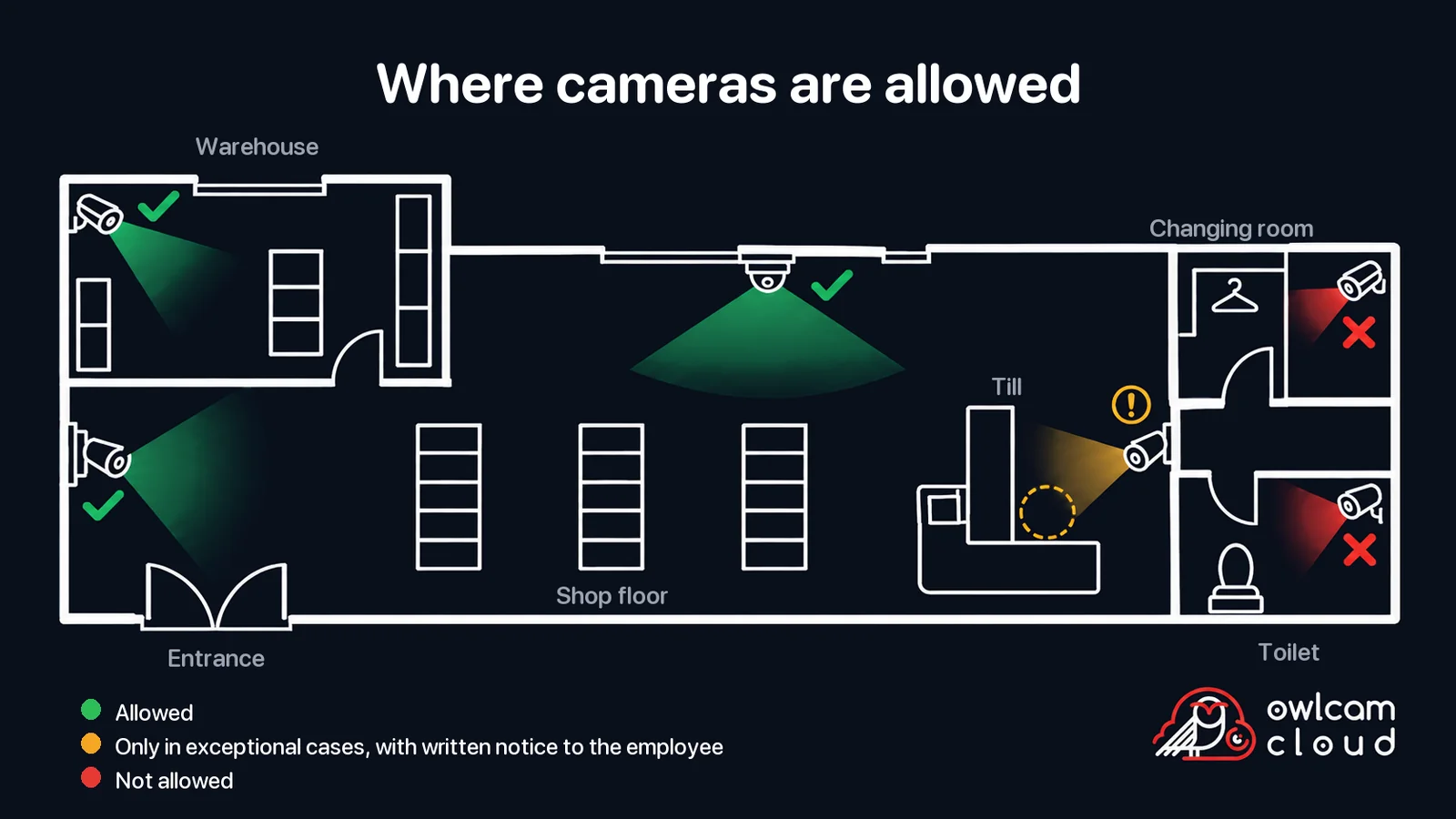
Cameras are prohibited in changing rooms, toilets and other places where people can reasonably expect privacy, and wherever monitoring would go against generally accepted moral standards (Article 10, paragraph 4). The fine for this violation is 2.5–3 times higher than for other breaches of the video monitoring rules.
Cameras and employees
Monitoring an employee's workplace is allowed only in exceptional cases — when the purpose cannot be achieved by other means, or doing so would take disproportionate effort (paragraph 3). Even then, the employee must be warned in writing, with the specific purpose stated (paragraph 8). A sign at the entrance is not enough for this.
In practice: a camera on the shop floor, in the warehouse or at the entrance is a normal situation. A camera aimed at a specific workstation needs a justification and written notice.
Sound is a separate matter
The law treats video and audio recording separately, and the rules for sound are stricter (Article 11).
Video | Sound | |
|---|---|---|
When allowed | for the listed purposes, if proportionate | with the person's consent; to make a record; to protect important legitimate interests with specific safeguards; in cases expressly provided by law |
Written decision | yes | yes, and in advance |
Warning | a sign | warn before recording starts and explain the right to object; the system's owner must prove the person was warned |
So if a camera records sound and there is no legal basis for it, the simpler and safer option is to turn sound off in the camera settings.
If you have a private house or apartment
The law does not apply when a person records video purely for personal and household purposes unconnected with business (Article 2). A camera in the yard of your own house pointed at your own plot usually falls under this.
Apartment buildings have separate rules: cameras in the entrance and common areas need the written consent of more than half of the owners, and a camera at your own door may be installed only so that it does not harm your neighbours' interests (Article 10, paragraphs 6 and 7). More on this in the article on video surveillance in residential buildings.
If someone asks to see a recording
A person caught on camera has the right to a free copy of the recording of themselves. You must respond within 10 working days; in special cases the period can be extended by another 10 (Article 14). A request to delete a recording is handled within the same 10 working days (Article 16).
Fines
Fines are set in the law itself (Article 69). The amount depends on annual turnover: up to GEL 500,000 or above. For a first violation, a warning may be issued instead of a fine.
Violation | Turnover up to 500 000 ₾ | Turnover above 500 000 ₾ |
|---|---|---|
Breach of the video or audio monitoring rules | warning or 1 000 ₾ | warning or 2 000 ₾ |
The same with aggravating circumstances | 2 000 ₾ | 4 000 ₾ |
Cameras in a changing room, toilet or similar place | warning or 3 000 ₾ | warning or 5 000 ₾ |
The same with aggravating circumstances | 3 000 ₾ | 5 000 ₾ |
An aggravating circumstance is, for example, repeating the same violation within a year. The amounts for individuals and non-profit organisations are the same as for businesses with turnover up to GEL 500,000. Compliance is supervised by the State Audit Office, which has taken over the functions of the Personal Data Protection Service.
What if recordings are stored in the cloud
For the law, a cloud service is a processor: it stores recordings on behalf of the camera owner. A written contract with the processor is required, in which it undertakes (Article 36):
to process data only on the owner's instructions;
to ensure the confidentiality and security of the data;
to delete or return the data when the contract ends;
to provide the information needed to verify compliance with the law.
Another question is where the recordings physically sit. If a service stores them abroad, that is a transfer of data to another country, and the law sets additional conditions for it (Article 37). OwlCam Cloud stores recordings in a data centre in Georgia, so this question does not arise.
In short: a checklist
The purpose of monitoring is legitimate, and the cameras are proportionate to it.
There is a written decision: purpose, scope, retention period, access, deletion.
A sign with a camera image, name and contact details is in a visible place.
Access to recordings is restricted, and viewings are logged.
No cameras in changing rooms, toilets or similar places.
Employees whose workstations are monitored have been warned in writing.
Sound is not recorded without a separate legal basis.
There is a contract with the cloud service.
Need help setting up cameras or an access log? Contact us — we'll help you organise recording storage by the rules.